Optiver 80-in-8 vs Zetamac
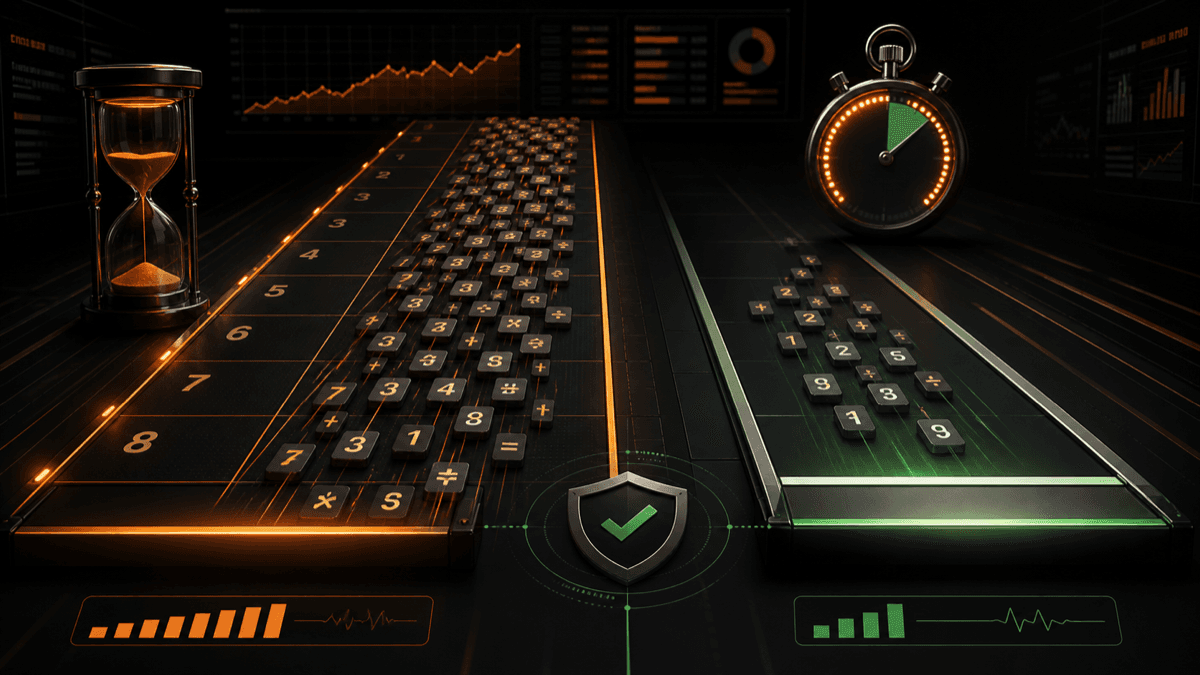
Search for Optiver interview prep and "80 in 8" appears everywhere. The awkward part is that the official Optiver pages we reviewed don't publish a current assessment contract with that name.
So this comparison has to keep two things separate. Zetamac is a two-minute arithmetic game you can inspect directly. The 80-in-8 format is a widely reported practice format, not an official specification we can verify.
Official, reported, and practice labels
Official: Optiver's September 2025 US campus recruiting Q&A discusses how mental math relates to trading and how candidates should prepare for online assessments. It also gives candidates a useful warning: information on the internet may be out of date (Optiver Q&A, verified August 12, 2026).
Optiver's early-career page says candidates do not need prior trading or finance experience and that the process looks at how they think and learn (early careers, verified August 12, 2026).
Reported: An independent trainer describes 80 arithmetic questions in eight minutes, or roughly six seconds each, with negative marking. That site says it isn't affiliated with Optiver and labels its score tiers as community-reported (80-in-8 trainer, verified August 12, 2026).
Wall St Math practice: the presets below are ours. They are not an Optiver replica.
Format comparison
| Dimension | Reported 80-in-8 | Zetamac | Wall St Math Classic |
|---|---|---|---|
| Duration | 8 minutes reported | 2 minutes on canonical page | 120 seconds |
| Pace | 480 ÷ 80 = 6 seconds/question | Varies with question difficulty | Varies; strict answer checking, no Skip |
| Operations | Reported arithmetic screen | Addition, subtraction, multiplication, division | Same four operations |
| Penalties | Negative marking reported, exact rule unverified | Canonical page does not state penalty scoring | Wrong answers remain until corrected; score counts correct completions |
| Cutoff | Not established by official source | No employer cutoff | No employer benchmark |
Zetamac's canonical page gives you two minutes to solve as many arithmetic problems as possible and lets you configure the ranges (Zetamac, verified August 12, 2026). That makes it a useful baseline. A Zetamac result is still a Zetamac result, not an Optiver score.
Why scores do not convert
An 80-in-8 report covers 480 seconds. Classic covers 120 seconds. 480 ÷ 120 = 4, which makes the temptation obvious: take a Classic score and multiply it by four. Don't. The question mix, response rules, and any penalty scoring differ.
Use the same contract for trend analysis. Wall St Math keeps Custom runs tied to their duration, operations, ranges, and Skip policy. A Desk score is not a Classic score.
What six seconds per question really means
Eight minutes is 8 × 60 = 480 seconds. At 80 questions, the average is 480 ÷ 80 = 6 seconds per question. That tells you the pace. It says nothing about a pass score.
Likewise, 48 completed questions in eight minutes is 48 ÷ 8 = 6 completed questions per minute. We can't tell you whether 48 is good, bad, or enough, because the official source doesn't tell us either.
Start with a supported preset
Start Classic Sprint and read the exact rules before beginning. For a broader finance calculation routine, use Drill Setup. Wall St Math does not reproduce Optiver's assessment.
Claims to be skeptical of
Be wary of pass marks, "guaranteed" question mixes, exact negative-marking amounts, and neat Zetamac-to-Optiver score conversions. Without a current official source, those are claims rather than facts. Candidate anecdotes are more useful when they include a date, role, and location.
Pacing, accuracy, and skip strategy
The reported six-second average is a budget, not an order to guess. If your assessment instructions confirm negative marking, follow them. Until then, practice two modes separately:
- ▸Accuracy mode: answer only when the route is clear; record the arithmetic pattern that caused the miss.
- ▸Pace mode: use a fixed timer and accept that some questions will remain unresolved; review them after the run.
Don't blend the two modes into a score that pretends to be an employer result. Classic makes you correct a wrong answer and has no Skip. A penalty-based screen may reward leaving a question alone. Same arithmetic, different behavior.
A four-stage practice plan
▸Stage 1: Build reliable anchors
Practice 10%, 25%, halves, doubles, multiplication by 9, and multiplication by 11. Get the common transformations automatic before you make the clock the main character.
▸Stage 2: Stabilize a fixed contract
Run Wall St Math Classic for three sessions. Keep its 120-second duration, four operations, and ranges unchanged. Record correct answers, corrections, and the operation that caused the longest pause.
▸Stage 3: Add endurance
Complete two or three same-contract runs with a short break. Compare only like-for-like runs. A score change after switching to Desk or Custom is not a clean progress measure.
▸Stage 4: Rehearse the invited assessment
When Optiver sends current instructions, copy the duration, response type, question mix, and penalty rule into your notes. If a third-party trainer differs, write down the difference. Averaging two rule sets doesn't create a more authentic one.
Ten questions to solve before adding speed
This is a Wall St Math practice set, not an Optiver assessment. Solve it cleanly before worrying about pace.
- ▸
37 + 48 = 85. - ▸
92 − 37 = 55. - ▸
12 × 24 = 288. - ▸
144 ÷ 12 = 12. - ▸
15% of 240 = 36(10% = 24,5% = 12). - ▸
9 × 84 = 756(10×84 − 84). - ▸
11 × 73 = 803(10×73 + 73). - ▸
420 to 495: change 75;75 ÷ 420 = 0.178571…, so about 17.86%. - ▸
25 bps = 0.25%. - ▸
3/5 = 60%.
Recheck the percentage answers with a second route. For item 8, 420 × 0.18 = 75.6, so 17.86% fits a near-18% increase. The set trains arithmetic patterns. It doesn't reveal a hidden firm cutoff.
Mistakes that distort comparisons
▸Using community score tiers as official
The independent 80-in-8 trainer explicitly labels its score tiers community-reported and non-affiliated. Keep that label in any quote or table.
▸Multiplying a score by four
Eight minutes is four times 120 seconds, but question difficulty and scoring rules are not linear. 4 × is a time ratio, not a score conversion.
▸Skipping the role and region
Optiver's official Q&A is a campus recruiting page. It cannot establish that every geography, role, or hiring cycle uses identical assessment content.
▸Practicing only raw arithmetic
Optiver's official trading page discusses probabilistic decisions under uncertainty. Arithmetic matters, but nobody should mistake it for the whole job.
Choose the next practice format
Use Classic Sprint for a fixed arithmetic contract, Drill Setup for focused operations, and the trading-interview guide for probability and communication practice.
Settings to record before practice
Write down the contract before starting a run. At minimum record:
- ▸question count or open-ended timer;
- ▸total duration and average time budget;
- ▸answer format (typed, multiple choice, or other);
- ▸whether skipped or wrong answers are penalized;
- ▸operation mix and numeric ranges;
- ▸whether the result is personal history, public ranking, or neither.
The official Optiver pages we reviewed don't fill in all of those rows for an 80-in-8 test. Leave the blanks blank until your invitation supplies the rules. A stale screenshot is not better evidence just because it has numbers on it.
Question-mix practice without pretending to know the mix
Build a balanced warm-up from common arithmetic families, then adapt when the employer supplies a real mix:
| Family | Example | Check |
|---|---|---|
| Addition/subtraction | 87 − 39 | Estimate first: answer near 50 |
| Multiplication | 14 × 27 | 14×20 + 14×7 = 378 |
| Division | 360 ÷ 12 | Reverse-check 12×30 = 360 |
| Percent | 7.5% of 240 | 5% + 2.5% = 12 + 6 = 18 |
| Fraction/proportion | 3/8 as a percent | 3 ÷ 8 = 0.375 = 37.5% |
This is our idea of a balanced warm-up. It is not Optiver's published question mix.
A skip decision tree
If the live assessment specifies negative marking, decide before the clock starts when a guess stops being worth it. Skip when the stated penalty makes guessing unattractive and you can't even estimate a range. With no penalty, the choice may be different. Classic can't train that decision because it has no Skip and keeps a wrong answer visible until you correct it.
Recovery after a bad run
One bad run doesn't call for wider ranges and twice the timer. Work out what actually failed:
- ▸Knowledge: you did not know a multiplication or fraction anchor.
- ▸Process: you chose a slow route.
- ▸Input: the calculation was right but the typed answer was wrong.
- ▸Fatigue: accuracy fell after repeated sessions.
Choose the next setting from that diagnosis. You don't need an official score benchmark to know that a missing multiplication fact calls for different practice than a mistyped answer.
A one-page comparison worksheet
Before starting, fill in the following rows for the product or assessment you are actually using:
| Row | Your entry |
|---|---|
| Source URL and date | |
| Official, reported, or product recommendation | |
| Duration | |
| Number of questions | |
| Response and skip rule | |
| Penalty rule | |
| Operations/ranges | |
| What the score measures | |
| What it does not measure |
The last two rows are the important ones. A narrow arithmetic result is not a broad measure of trading ability. If the official fields are blank, write "not published" instead of guessing.
A larger total can hide worse accuracy
Suppose you answer 30 questions with 27 correct. Accuracy is 27 ÷ 30 = 90%. On the next run you rush through 50 and get 35 right; 35 ÷ 50 = 70%. The bigger raw total hides a much messier run. Track both counts while training, then use the employer's actual scoring rule when you receive it.
After the arithmetic
After the arithmetic, move on. Optiver's public trading page discusses probability, order flow, risk, and market structure, so practice expected value and explaining a decision under uncertainty. Zetamac and Wall St Math can supply arithmetic volume. Neither can stand in for the rest of the role.
Sources and verification
- ▸Optiver US campus recruiting Q&A - official, 2025-09-22; checked 2026-08-12.
- ▸Optiver early careers - official; checked 2026-08-12.
- ▸80-in-8 trainer - reported/non-affiliated; checked 2026-08-12.
- ▸Zetamac - primary product page; checked 2026-08-12.
- ▸Wall St Math feature details - verified against the August 12, 2026 product build.
Article Info
Related Topics
Related Posts
Practice These Strategies
Train these techniques with timed drills across 7 categories and 21 subtypes.
[ START A SPRINT ][ PRACTICE BASICS ]